
Sub-Zero repair or replace?
Repair or Replace Your Sub-Zero in Fremont
An honest, failure-by-failure look at when a Sub-Zero is worth fixing and when it is time to start over — built around real Fremont costs, the Classic-vs-current question, and the price of swapping an integrated built-in.
- We do not sell appliances
- Evidence, not a sales pitch
- $89 service call waived
- 365-day labor warranty
The short answer on repair vs. replace
On a Sub-Zero, repair almost always wins. Because a like-for-like integrated built-in runs $8,000–$18,000 installed in a Fremont kitchen, even a sealed-system repair at $1,450–$3,600 is the cheaper path — and door seals, fans and boards are a small fraction of that. Replacement only makes sense when a major sealed-system failure stacks on an already-aging unit, when the repair nears half a true replacement, or when a part simply cannot be sourced. Call (650) 668-1172 for an evidence-based answer.
The question behind every big Sub-Zero quote
When a built-in worth thousands acts up, the real question is rarely "what is wrong?" — it is "do I sink money into this, or start over?" That decision plays out differently in Fremont than almost anywhere else, because the housing stock here splits so cleanly: the Classic-generation built-ins running fifteen to twenty years in Mission San Jose and Niles estates, and the newer integrated units set into Warm Springs and Innovation District new-builds that may still be inside a manufacturer term.
This page is the honest version of that conversation. We do not sell appliances, so we have nothing to gain from steering you toward a replacement — and on a Sub-Zero, the math usually favors the repair by a wide margin. Here is how to think it through before you spend.
The 50% rule — and why it sits so high on a Sub-Zero
The common rule of thumb is to replace an appliance when one repair costs more than about half of replacing it. That rule punishes cheap fridges, where replacement is a few hundred dollars. A Sub-Zero flips it: replacing an integrated built-in with panels and cabinetry routinely runs $8,000–$18,000 installed, so the 50% line sits thousands of dollars up — which is exactly why almost every repair we quote clears it.
| What failed | Lean | Why |
|---|---|---|
| Door seal, hinge or frost-line | Repair | A small fraction of replacement cost and the unit is otherwise sound — almost never a replace. |
| Evaporator / condenser fan or damper | Repair | Economical airflow parts; restores full cooling on a cabinet built to last decades. |
| Control board or temperature sensor | Repair | Boards and sensors are available for most platforms and far cheaper than a new built-in. |
| Single sealed-system / compressor fault on a sound unit | Usually repair | At $1,450–$3,600 it still undercuts a five-figure swap when the rest of the unit is healthy. |
| Sealed-system failure on a very old, multi-fault unit | Discuss | When other parts are also aging, a big repair may not be the last one — worth weighing replacement. |
| Cosmetic damage only (panel, handle, trim) | Repair / leave | A cooling unit with cosmetic flaws is not a replacement candidate; parts or panels fix the look. |
| Discontinued configuration with no sourceable parts | Replace | The rare genuine replace case — when the right part simply cannot be obtained. |
General guidance; we confirm the fault with evidence before recommending either path.
Age, the Classic line, and why old is not the same as finished
Plenty of Fremont homes still run a Classic-generation Sub-Zero — the flush built-in side-by-sides and paired columns that defined the kitchen for a generation. Owners assume fifteen or twenty years means "time is up." It usually does not. These platforms were over-engineered for longevity, and the parts that wear — fans, gaskets, hinges, defrost components, boards — are largely still available and individually inexpensive.
What actually shifts the decision is not the number on the calendar but the pattern of failures. One worn part on an otherwise healthy unit is a clear repair. A second sealed-system event, or several aging systems lining up at once, is when keeping it stops being obviously cheaper. We read that pattern honestly rather than defaulting to "it is old, replace it."
What pushes the decision each way
Toward repair
The fault is a single, well-understood part; the cabinet, doors and sealed system are otherwise sound; parts are available; replacement would mean cabinetry work you do not want.
Toward replace
A confirmed sealed-system failure stacks on top of other aging systems; the realistic repair nears half of a true replacement; or the exact part for a discontinued unit cannot be sourced.
The Tri-City water factor
Years of moderately hard Alameda County water add quiet load to the valve, ice system and sealed loop — a reason an older local unit may show wear a touch sooner.
The time factor
A repair is usually days; a like-for-like integrated replacement can mean weeks of lead time plus an installer and a cabinet crew. Food does not wait that long.
What replacing actually costs in a Fremont kitchen
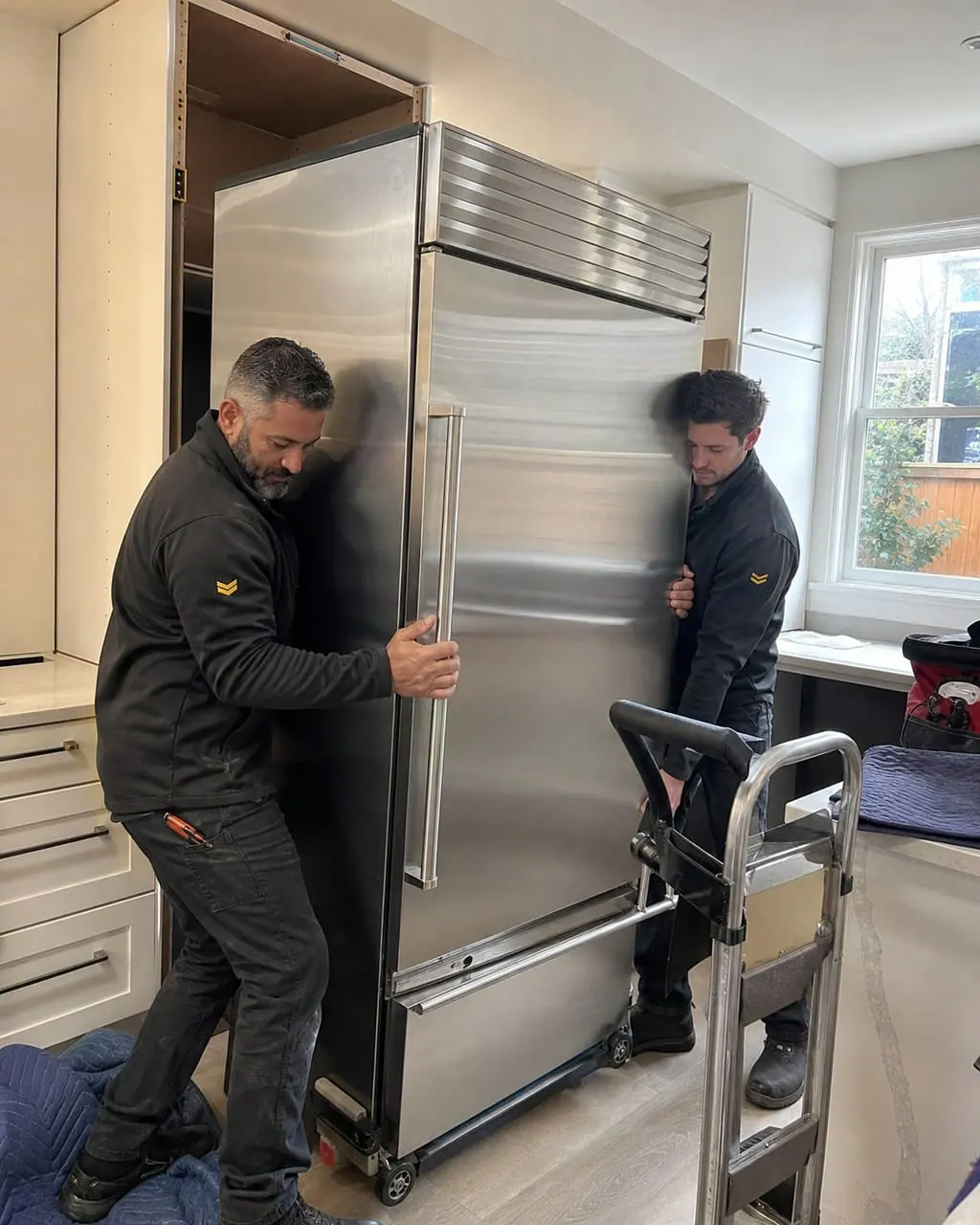
The sticker on a new built-in is only the start. A genuine like-for-like swap of an integrated column or built-in side-by-side means delivery of a heavy unit, professional installation, transferring or remaking the custom panels that hide it, and — in a remodeled Mission San Jose or Warm Springs kitchen — adjusting the surrounding cabinetry so the new unit sits flush. Add Alameda County haul-away and disposal of the old appliance, and the all-in figure commonly lands between $8,000 and $18,000.
Stand a repair next to that. A door seal, a fan or a board is a few hundred dollars; even the most involved sealed-system or compressor work tops out around $3,600. For the full picture of what individual jobs run, see our repair pricing page — then compare it honestly to the replacement number above.
When we will tell you to replace
We would rather lose a repair than talk you into one that will not pay off. We point toward replacement when:
- A confirmed sealed-system or compressor failure lands on a unit that already has several other components near end-of-life
- The honest, evidence-based repair cost approaches roughly half of a realistic installed replacement
- The exact OEM part for a discontinued configuration genuinely cannot be sourced
- A second major fault appears soon after a first big repair, signalling the unit is winding down as a whole
- You are already mid-remodel and the cabinetry is open anyway, which removes most of the replacement premium
Get a straight answer for your unit
The only way to decide well is with real evidence, not a phone guess. Have your model and serial number ready so we can read the unit's age and platform, then call (650) 668-1172 or book online. If you own a Classic side-by-side, our 600 Series repair page goes deeper on that platform; if both compartments are drifting warm, start with not cooling. Want to extend the life of a unit you decide to keep? The maintenance guide and our water-filter schedule for hard Tri-City water are the place to start.
Facing a big quote and not sure it is worth it? Tell us your model and the fault and we will give you the honest repair-or-replace numbers. The $89 service call is waived when you book the repair.
Honest decisions, reviewed
Fremont owners on getting a straight repair-or-replace answer.
675 reviews · 4.9 / 5
Got a straight answer on cost before they drove out. The diagnostic fee was waived once I approved the repair, and the final number matched the estimate. No surprise add-ons — rare for built-in refrigeration work.
Part for our 600-series column had to come in, so it took a second visit, but they kept me posted both times and the repair has held perfectly. Polite, tidy, and careful with the custom panel.
Classic 632 side-by-side that the previous company gave up on. These folks knew the platform cold — magnetic door issue and a tired evaporator fan. Running like new and they stand behind the labor for a year.
Repair or replace a Sub-Zero — FAQ
Is it worth repairing a Sub-Zero, or should I just replace it?
For the vast majority of faults we see in Fremont — door seals, fans, dampers, control boards, defrost parts, even most compressor work — repair wins easily, because a like-for-like built-in replacement runs into five figures once cabinetry is counted. The decision only tilts toward replacement when a major sealed-system failure lands on a unit that is already old enough to have several other parts near the end of their life. We use a simple guide: if the verified repair costs more than roughly half of a realistic replacement, we talk it through honestly.
What is the 50% rule for a built-in refrigerator?
It is a planning rule of thumb, not a law: when a single repair would cost more than about half of what replacing the appliance would realistically cost, replacement starts to make financial sense. The catch with Sub-Zero is that "replacement cost" for an integrated built-in is far higher than for a freestanding fridge — often $8,000 to $18,000 installed once you add panels and cabinetry rework — so the 50% threshold sits much higher than people expect, and most repairs clear it comfortably.
My Sub-Zero is 15 to 20 years old — is it too old to fix?
Age alone rarely condemns a Sub-Zero. The Classic-generation built-ins in many Mission San Jose and Niles homes were engineered to run for decades, and parts for the long-lived platforms are largely still available. What matters is the specific failure and how many other components are aging alongside it. A 17-year-old unit needing one fan or gasket is an easy fix; the same unit on its second sealed-system fault is a different conversation.
How much does it really cost to replace a built-in Sub-Zero in Fremont?
A like-for-like integrated or column replacement is rarely just the price tag on the appliance. Between the unit, delivery, professional installation, refitting custom panels, and any cabinetry adjustment around a remodeled Fremont kitchen, owners commonly land between $8,000 and $18,000 — and there can be a wait for the model. Against that, even a sealed-system repair in the $1,450–$3,600 range is usually the cheaper, faster path.
Does hard Tri-City water change the repair-or-replace math?
It can, indirectly. The moderately hard water across Fremont, Newark and Union City leaves scale that, over years, adds load to the inlet valve, the ice system and ultimately the compressor and sealed system. It does not condemn a unit on its own, but it is one reason an older Tri-City built-in may show sealed-system wear a little sooner — which is worth factoring in when you are weighing a big repair against replacement.
When will you actually tell me to replace instead of repair?
When the numbers say so. We recommend replacement when a confirmed sealed-system or compressor failure lands on a unit that already has multiple aging components, when the cost of doing it right approaches half of a realistic replacement, or when parts for a discontinued configuration genuinely cannot be sourced. We show you the pressure and electrical evidence and the real figures so the call is yours — we do not sell appliances, so we have no reason to push one.

Big quote on the table? Get the honest numbers first.
Call the Tri-City dispatch line or book online. The $89 service call is waived when you book the repair, and every job is backed by a 365-day labor warranty.