
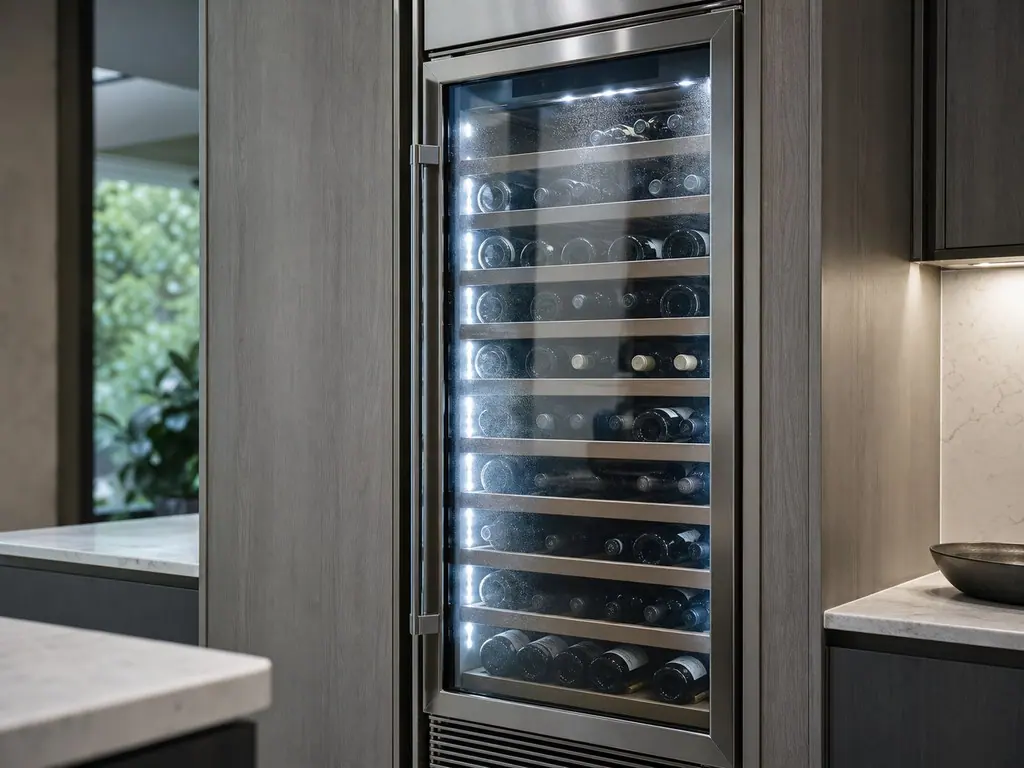
A wine cooler is the one appliance in the house that fails quietly. A refrigerator warns you with a warm gallon of milk; a Sub-Zero wine unit can drift two or three degrees off for a whole Fremont summer and the only evidence is a Cabernet that opened older than it should have.
That is why owners across Centerville, Irvington and the Niles flats tend to call us after a stored vintage tastes off, not before. This guide walks through the warning signs a wine cooler actually gives you, and what each one usually means once a technician is standing in front of it.
The dual-zone sensor is the usual suspect
Sub-Zero wine coolers run as one zone or two, and the two-zone units carry a separate thermistor and damper for the upper and lower cabinet. That sensor is the part we replace most. When a thermistor reads high, the control thinks the zone is colder than it is and eases off the cooling, so the zone quietly creeps warm — exactly the slow drift that ages a bottle without ever tripping an alarm. The fix is a genuine OEM sensor and a calibration check against a known probe, not a guess at the whole sealed system.
If only one zone drifts while the other holds, that is almost always the damper or sensor for that zone, which is good news: it is a targeted repair, not a compressor job.
Airflow, the condenser and a Fremont summer
A Sub-Zero wine cooler rejects its heat through a condenser behind the lower grille, and that grille pulls in household dust and pet hair all year. In Fremont's dry inland summer, when the kitchen itself runs warm in the late afternoon, a loaded condenser is the difference between a unit that holds 55 degrees and one that fights to stay under 60. The cooler runs longer, the compressor works harder, and the cabinet still drifts up on the hottest days.
Clearing and brushing the condenser is routine, but if the evaporator fan has worn bearings or iced over you will hear it — a faint rattle or a unit that suddenly cannot keep up. That fan is a stock part and a same-visit replacement on most platforms.
Seals, UV glass and vibration
Two quieter failures round out the list. The door gasket and the UV-tinted glass seal keep conditioned, humidity-controlled air inside; when a gasket hardens or a glass seal weeps, you get fogging on the inside of the door, a sweating cabinet, and humidity the unit can no longer hold steady. A dollar-bill test around the door tells you fast whether the gasket still grips.
The other is vibration. A compressor mount or fan going out of balance sends a constant tremor through the rack, and steady vibration disturbs the sediment in older reds and tires a cork over time. A wine cooler that has started to buzz is worth diagnosing before the bottles pay for it.
Repair or replace
Most Sub-Zero wine cooler faults we see in Fremont are repairs, not write-offs — a sensor, a fan, a gasket, a condenser clean. The sealed system itself rarely fails, and when it does on a unit still in its first decade it is usually worth the fix given what a built-in replacement costs to buy and re-trim into cabinetry. We will tell you honestly when a unit is genuinely past it, but that is the exception.
We service Sub-Zero wine coolers throughout Fremont with genuine OEM parts; the $89 service call is waived when you book the repair, and the work carries a 365-day labor warranty. One clarification owners often ask about: wine storage is a Sub-Zero product. Its sister brand Wolf makes ovens and cooktops, so a wine cooler is always a Sub-Zero repair, never a Wolf one.